The clinical question
We often reach the end of an ED syncope patient assessment without a cause. The patient looks well, but the worry remains: will we miss something important if we send them home? This study asked whether hospitalisation detects more serious adverse outcomes than discharge in adults ≥40 with unexplained syncope or presyncope.
The study
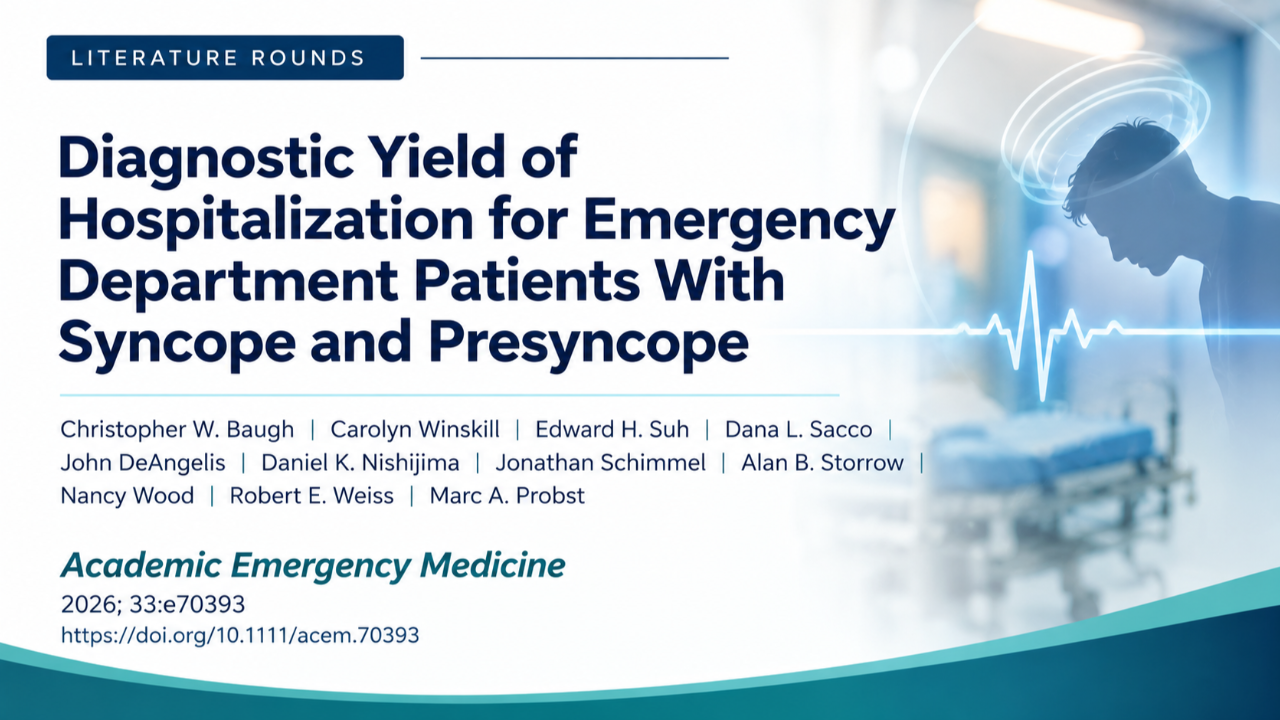
Baugh CW, et al. Diagnostic Yield of Hospitalization for Emergency Department Patients With Syncope and Presyncope. Acad Emerg Med. 2026;33:e70393.
This was a prospective, multicentre, observational cohort across six US emergency departments. It included 1,263 patients with a mean age of 64.8 years, of whom 44.6% were hospitalised and 55.4% were discharged. Patients already diagnosed with an important cause in the ED (such as significant arrhythmia, MI, PE, aortic dissection, significant haemorrhage, sepsis or intracranial haemorrhage) were excluded.
The primary outcome was a serious adverse outcome (SAO) within 30 days. This included death, significant arrhythmia, MI, significant structural heart disease, PE, stroke and cardiac intervention, among others.
What they found
- 9% had an SAO within 30 days, and 4.9% had a serious cardiac outcome.
- Significant arrhythmia was the commonest SAO (2.9%).
- Hospitalisation was associated with higher odds of detecting an SAO (adjusted OR 3.70, 95% CrI 1.85–6.82).
- Detection was also earlier, with a mean time to diagnosis of 3.8 days.
It depends on risk (the FAINT score)
| FAINT score | Result |
| 0 (low risk) | No demonstrated difference (OR 1.57, 95% CI 0.14–17.53) |
| ≥1 | Significantly greater yield with admission (OR 3.35, 95% CI 1.78–6.31) |
The confidence interval in the FAINT SCORE = 0 group is very wide, so the study can’t say admission and discharge are equivalent.
Limitations
- Not randomised. Clinicians chose who to admit, and hospitalised patients were older and sicker (more heart failure, CAD, abnormal ECGs and raised biomarkers). Residual confounding is unavoidable.
- Yield is not benefit. The study doesn’t show lower mortality, fewer injuries, less recurrence or better quality of life.
- Surveillance bias. The real question may be prolonged monitoring versus limited monitoring. The authors mention ambulatory patch monitors and implantable loop recorders as alternatives.
- Admission has harms. Earlier work reported a 13% rate of adverse events (delirium, hypoglycaemia, falls) in low-risk syncope admissions.
Take-home points
- Serious pathology wasn’t rare (5.9%).
- Hospitalisation found more, and found it sooner.
- Arrhythmia was the main signal.
- The yield was minimal in FAINT = 0 and substantial in FAINT ≥1.
- This shows an association with more diagnoses, not proof that admission improves outcomes.
My thoughts
In adults ≥40 with unexplained syncope or presyncope, hospital-based monitoring increases the detection, and speeds the diagnosis, of serious pathology, particularly in patients with cardiac risk features. The additional yield appears minimal in patients classified as low risk by FAINT.