Are patients with valvular atrial fibrillation(AF), at high risk of stroke if we cardiovert them? What if they present already anti coagulated? I am assuming in this discussion that the patients are haemodynamically stable.
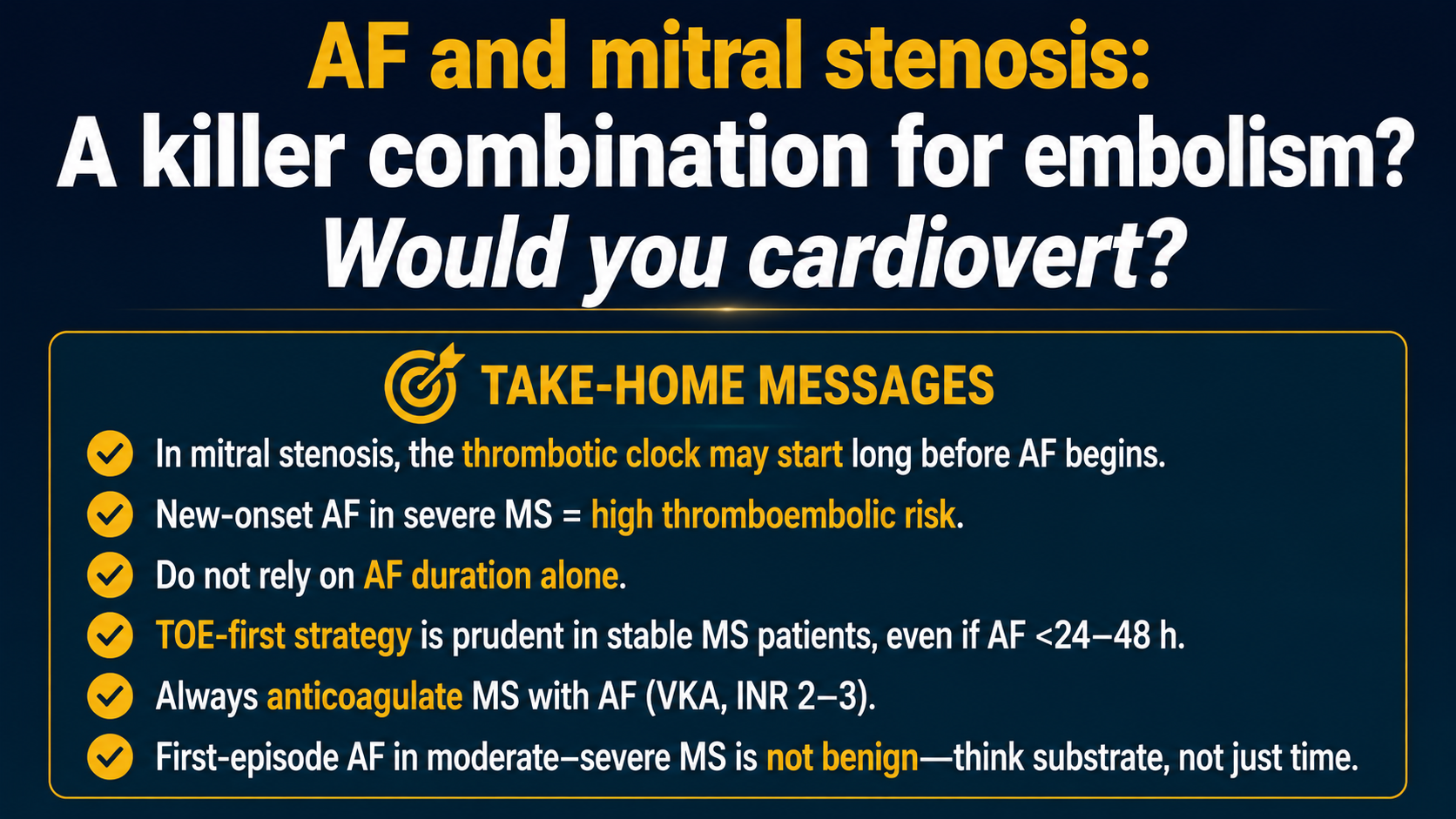
I believe that these are high risk patients and I discuss them with cardiology, for a potential transoesophageal echo (TOE), when they present. The thrombotic clock may start long before AF begins.
Here is why. I would be interested in what you all do.
Patients with valvular AF are known to be of higher thromboembolic risk and are required to be anticoagulated with Vitamin K antagonists(VKA). However Valvular AF is an outdated term. What we are referring to specifically, is mitral stenosis(MS) and mechanical heart valves(MHV). The other valvular abnormalities such as aortic regurgitation, or aortic stenosis, or bioprosthetic heart valves etc, aren’t included in this definition.
The questions that need aswering are:
- Does the patient with first presentation with AF, with onset less than 24 hours and moderate to severe MS, have a higher risk of stroke if cardioverted without a prior normal TOE? (They may need a TOE to determine the severity of their MS, if not already done so
- Does the patient with moderate to severe MS, who has already been anticoagulated for greater than 3 weeks for AF, have a higher risk of embolisation, when cardioverted without a prior normal TOE?
The guidelines are the best evidence we have, but not definitive evidence and the evidence in valvular AF is weak. It is because the evidence is so weak, that two guidelines can say something totally different (see below).
- The guidelines on AF cardioversion, don’t deal with moderate to severe MS patients, they lump everyone in the same category. The only difference is that anticoagulation of MS patients must be with a VKA.
- There is no indication in the AF guidelines that MS should be taken into account when deciding to cardiovert a patient.
- The guidelines differ in the safe defibrillation times allowed, all based on the same evidence and no new evidence.
- The American Heart Asssoication (AHA) allows a window of 48 hours from AF onset. It doesn’t refer to MS as a risk factor for thrombus formation, but uses the accepted CHA₂DS₂-VASc score. However it does recognise that patients with MS are a high risk thromboembolic population and recommends long term VKA anticoagulation irrespective of CHA₂DS₂-VASc score.
- The European Society of Cardiology (ESC) allows a 24 hour window for cardioversion of new AF. However the answer is not in the AF guidelines, but in the valvular guidelines.
The ESC/EACT Valvular Heart Disease guideline 2025,(1) states that new onset AF in severe MS is a “high thromboembolic risk”. These patients should be anticoagulated with a VKA and not DOACs. This is not dependent on CHA₂DS₂-VASc scores. Recommendation in this patient group, includes that these patients should not be cardioverted until the valve abnormality is repaired.
It recognises these patients as high risk and states that even those that remain in sinus rhythm should be anticoagulated if they have previous systemic emboli or a left atrial(LA) thrombus. These patients require a TOE to determine if there is dense spontaneous contrast, or significant LA enlargement (>50mm diameter of LA volume > 60 mL/sqm).
If we look at this clinically, lets consider the following patient:
A 42 yo haemodynamically stable male with MS (Mitral Valve Area(MVA) 1.2 cm²), presents with new onset AF 8 hours ago. His CHA₂DS₂-VA = 0. How would you treat this patient?
According to the guidelines we would cardiovert this patient and not necessarily use pericardioversion, or long term anticoagulation.
However with an MVA ≤1.5cm² and new AF, this patient is a HIGH THROMBOEMBOLIC RISK.
The evidence is poor in terms of thromboembolic events post cardioversion in MS patients. In patient with severe MS, the recommendation is not for cardioversion until the valve is repaired.
What do we know about thrombus formation?
Most of what we know about thrombus formation and stroke in AF, is related to non-valvular AF. In non-valvular AF, thrombus develops in approximately 90% of cases, in the left atrial appendage(LAA). In MS thrombus occurs outside the LAA, in the left atrium(LA). However the evidence for which is most likely to embolise is weak.
Thrombus formation in patients with MS can occur even if they are in sinus rhythm.
- In one study of 848 patients with MS and sinus rhythm(2), who were being evaluated for percutaneous transvenous mitral commissurotomy, 6.6% of patients in sinus rhythm, were found to have LA thrombus of TOE.
- In a single center prospective observational study of 179 patients with MS and sinus rhythm transient subclinical AF, in patients with MS resulted in a five-fold increase in stroke/systemic emboli, with an overall embolic event rate of 5.3/100 patient years.(3)
What if a patient is already anticoagulated for more than 3 weeks?
One study of 490 patients with severe MS and AF, found that 33% of patients had LA or LAA thrombus at baseline. In those patients subsequently anticoagulated for 6 months(4):
- LAA thrombus had resolved in 94% of patients (small numbers 31/33)
- LA body thrombus had only resolved in 12% of patients (2/17)
We can’t extrapolate and say that LA thrombus is 8 times more likely to be present with stroke than thrombus in the LAA, following 6 months of anticoagulation. What we might potentially be able to say is that LA thrombus is more associated with MS and AF, than is thrombus in the LAA and it is more likely to be present even with anticoagulation.
Above are the reasons why I discuss these patients.
References
- Praz, F et al. 2025 ESC/EACTS Guidelines for the management of valvular heart disease. European Heart Journal (2025) 46, 4635–473
- Manjunath CN et al. Incidence and predictors of left atrial thrombus in patients with rheumatic mitral stenosis and sinus rhythm: a transesophageal echocardiographic study. Echocardiography
2011 Apr;28(4):457-60
-
Karthikeyan G et al. Transient, subclinical atrial fibrillation and risk of systemic embolism in patients with rheumatic mitral stenosis in sinus rhythm. Am J Cardiol 2014 Sep 15;114(6):869-74.doi: 10.1016/j.amjcard.2014.06.016.
- Strimannarayana J et al. Prevalence of left atrial thrombus in rheumatic mitral stenosis with atrial fibrillation and its response to anticoagulation: a transesophageal echocardiographic study. Indian Heart J 2003 Jul-Aug;55(4):358-61.