Can we rely on conventional STEMI criteria to identify acute coronary occlusion following cardiac arrest?
Following return of spontaneous circulation (ROSC), the 12-lead ECG is an essential investigation for identifying acute coronary occlusion and determining the need for urgent coronary angiography. However, not all acute coronary occlusions produce conventional ST elevation. Patients may have an occlusive myocardial infarction (OMI) without meeting STEMI criteria.
A recent study published in Resuscitation examined the frequency of non-ST-elevation OMI patterns following cardiac arrest and whether ECG measurements could predict survival.
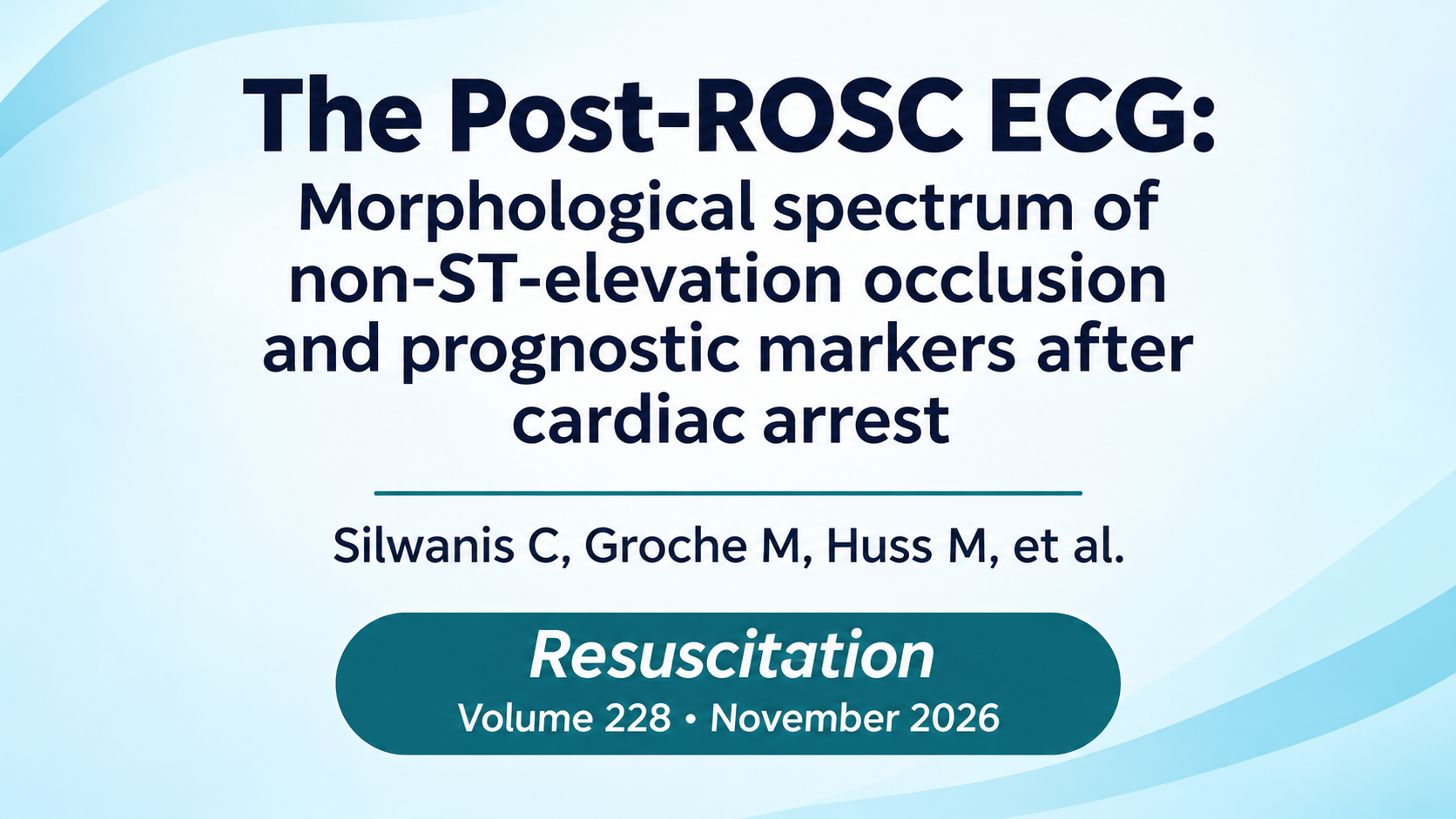
The study: Silwanis C, et al. The post-ROSC ECG: Morphological spectrum of non-ST-elevation occlusion and prognostic markers after cardiac arrest. Resuscitation. November 2026;228.
What They Did?
This was a retrospective, single-centre study involving 214 patients admitted following cardiac arrest with sustained ROSC. Of these, 164 underwent coronary angiography.
Investigators assessed the initial post-ROSC ECG for conventional STEMI criteria and recognised non-ST-elevation OMI patterns, including modified Sgarbossa criteria, left-main-equivalent patterns, Aslanger patterns and hyperacute T waves. They also examined whether ECG conduction intervals were associated with 30-day survival.
What They Found?
Among the 101 patients with angiography-confirmed OMI:
- 47.5% had non-ST-elevation OMI patterns.
- 43.6% met conventional STEMI criteria.
- 8.9% had neither recognised ECG pattern.
The most frequently identified non-ST-elevation patterns were the left-main-equivalent pattern and modified Sgarbossa criteria.
Adding OMI patterns substantially increased sensitivity
| ECG interpretation | Sensitivity for OMI |
|---|---|
| Conventional STEMI criteria | 43.6% |
| Non-ST-elevation OMI patterns | 47.5% |
| Combined STEMI + OMI patterns | 91.1% |
The combined approach had a specificity of 74.6%. This suggests that relying on STEMI criteria alone may miss a substantial proportion of coronary occlusions following cardiac arrest.
What About Coronary Angiography?
Patients with non-ST-elevation OMI patterns were less likely to undergo coronary angiography than those with conventional STEMI (78.4% versus 98%).
Interestingly, 30-day mortality among patients with non-ST-elevation OMI patterns was:
- 75% in those who did not undergo angiography.
- 34.5% in those who underwent angiography.
However, this was an observational study. Patients who did not undergo angiography may have been older, more critically ill or had a poorer neurological prognosis.
We cannot conclude that angiography itself was responsible for improved survival.
Can the ECG Predict Survival?
The investigators also found that prolongation of the PR segment was independently associated with reduced 30-day survival. This is an interesting finding, but further validation is required before PR-segment duration can be used for clinical prognostication.
Conclusion
The major message is that the absence of ST elevation does not exclude acute coronary occlusion following cardiac arrest. Clinicians should recognise non-ST-elevation OMI patterns and consider them alongside the clinical presentation, haemodynamic status, echocardiography and other evidence of ongoing myocardial ischaemia. However, this study does not establish that every patient with a non-ST-elevation OMI pattern requires immediate coronary angiography.
The Bottom Line
Conventional STEMI criteria identified fewer than half of patients with OMI in this selected post-cardiac-arrest cohort.
Adding recognised non-ST-elevation OMI patterns increased diagnostic sensitivity to 91.1%.
We need to look beyond STEMI when interpreting the post-ROSC ECG.
Read the Full Critical Appraisal on EM Mastery
In this week’s EM Mastery Literature Rounds, we examine this study in greater detail, including:
- The ECG patterns associated with coronary occlusion.
- The diagnostic performance of conventional STEMI versus OMI criteria.
- Whether the mortality findings support earlier coronary angiography.
- The study’s strengths, limitations and implications for emergency medicine practice.
Read the full Literature Rounds review on EM Mastery →