One of the challenges in managing intermediate-high-risk pulmonary embolism (PE) is deciding when to intervene.
These patients are haemodynamically stable but have evidence of right ventricular dysfunction and elevated cardiac biomarkers. Traditionally, we treat them with anticoagulation, monitor them closely and reserved reperfusion therapy for those who deteriorate.
But should we be waiting for them to deteriorate?
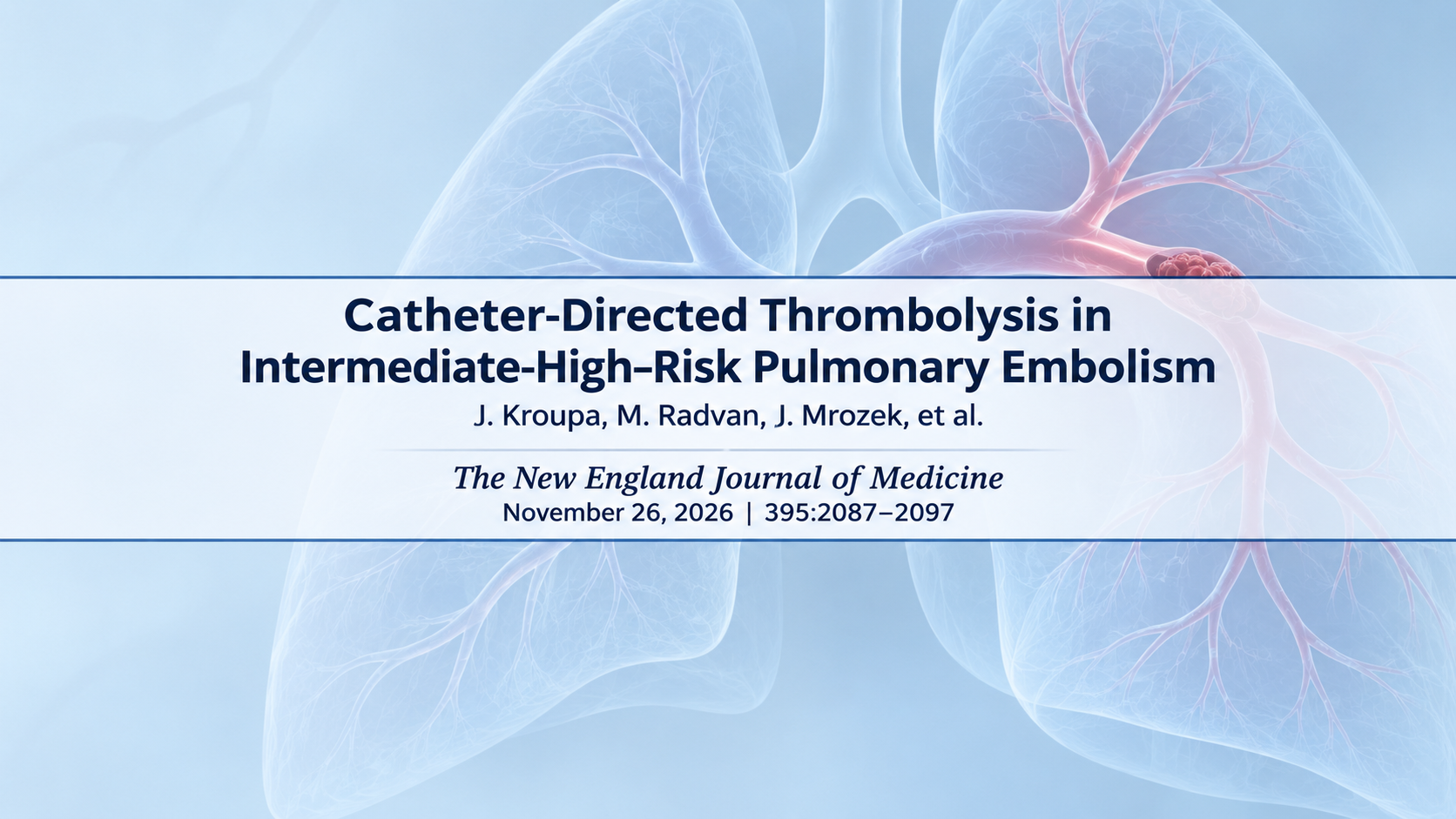
The PRAGUE-26 trial, challenges this approach by investigating whether early, low-dose catheter-directed thrombolysis can prevent clinical deterioration.
THE STUDY
Kroupa J, Radvan M, Mrozek J, et al.Catheter-Directed Thrombolysis in Intermediate-High–Risk Pulmonary Embolism NEJM 2026;395:2087–2097.
What they did?
In this multicentre randomised controlled trial, 558 patients with intermediate-high-risk PE were allocated to receive either:
-
Conventional catheter-directed thrombolysis using 10–20 mg of alteplase plus anticoagulation.
-
Standard anticoagulation alone.
The primary outcome was a composite of death, recurrent pulmonary embolism or cardiorespiratory decompensation or collapse within seven days.
What did they find?
The results were impressive.
| Outcome at 7 days | Catheter-directed thrombolysis | Anticoagulation alone |
|---|---|---|
| Primary composite outcome | 0.7% | 6.8% |
| Major bleeding (GUSTO) | 1.4% | 2.2% |
| Intracranial haemorrhage | 0.7% | 0% |
This represents a 90% relative risk reduction, with a number needed to treat of approximately 17.
The benefit however, was predominantly driven by a reduction in cardiorespiratory deterioration.
There was no statistically significant increase in major bleeding. However, two patients in the thrombolysis group developed intracranial haemorrhage, and a mortality benefit has not been established. The study had small numbers.
Importantly, the investigators achieved these results using conventional infusion catheters, without the need for specialised ultrasound-assisted technology.
Is this practice-changing?
This study strengthens the argument for early reperfusion in appropriately selected patients with intermediate-high-risk pulmonary embolism.
It does not mean that every patient with intermediate-high-risk PE should receive catheter-directed thrombolysis. However, it should prompt us to reconsider our threshold for early consultation with an interventional team.
A normal blood pressure does not necessarily mean that anticoagulation alone is the optimal treatment.
Read the full review on EM Mastery
In this week’s EM Mastery Literature Rounds, we explore the PRAGUE-26 trial in detail, including patient selection, thrombolysis dosing, bleeding complications, study limitations, comparisons with previous trials and the implications for our emergency medicine practice.
Should we be preventing clinical deterioration rather than waiting for it to occur?
Continue reading the full critical appraisal in EM Mastery Literature Rounds.
Reference
Kroupa J, Radvan M, Mrozek J, et al. Catheter-Directed Thrombolysis in Intermediate-High–Risk Pulmonary Embolism. N Engl J Med. 2026;395:2087–2097. DOI: 10.1056/NEJMoa2608012.