
The clinical question is whether first-degree AV block represents a harmless delay in conduction or an early marker of clinically important conduction system disease.
What is first-degree AV block?
First-degree AV block is defined by a PR interval greater than 200 ms, with every P wave followed by a QRS complex.
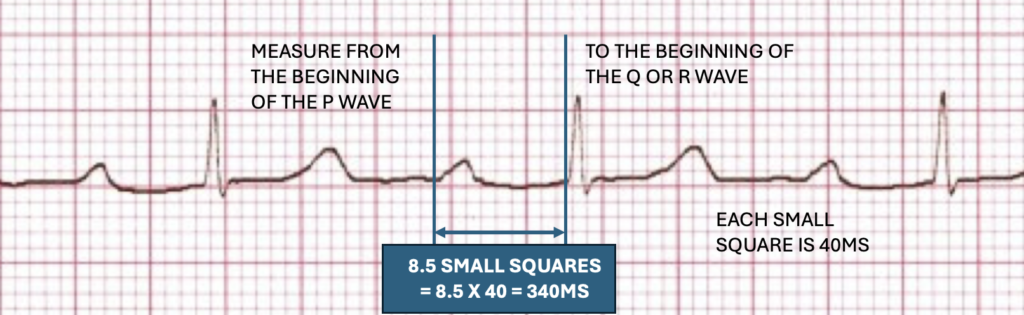 It represents delayed conduction rather than failure of conduction. The delay may occur in the AV node, His bundle or infra-Hisian conduction system.
The significance depends on the degree of PR prolongation, the site of conduction delay, associated ECG abnormalities, symptoms and underlying cardiac disease.
Importantly, a PR interval of 220 ms in an asymptomatic young adult is not equivalent to a PR interval of 340 ms in an older patient taking metoprolol and flecainide.
Why might first-degree AV block be a problem?
There are three concerns:
- Progression to higher-grade AV block. First-degree AV block may be a marker of underlying conduction system disease, particularly in patients with bundle branch block or structural heart disease.
- Haemodynamic consequences. Marked PR prolongation, particularly above 300 ms, may cause atrioventricular dyssynchrony. Atrial contraction occurs at an unfavourable point in ventricular filling, potentially producing fatigue, exertional intolerance, presyncope or symptoms resembling pacemaker syndrome.
- Drug-related conduction deterioration. Beta-blockers, non-dihydropyridine calcium-channel blockers, digoxin and certain antiarrhythmics can further prolong conduction. Patients with pre-existing conduction disease may be particularly vulnerable.
What does the evidence show?
The Framingham Heart Study — Cheng et al., JAMA 2009
This prospective cohort study followed 7,575 individuals and examined the long-term implications of PR prolongation.
Compared with individuals with normal PR intervals, those with first-degree AV block had:
2.06× Atrial fibrillation
2.89× Pacemaker implantation
1.44× All-cause mortality
Multivariable-adjusted hazard ratios, not absolute risks.
These associations persisted in analyses excluding patients taking AV nodal-blocking medications.
Interpretation: First-degree AV block is a prognostic marker, but this observational study does not establish that PR prolongation itself causes these outcomes or that treating an asymptomatic prolonged PR interval improves survival.
2018 ACC/AHA/HRS Bradycardia Guideline
The guideline highlights that marked first-degree AV block, particularly with a PR interval greater than 300 ms, may cause symptoms through AV dyssynchrony.
Permanent pacing is not recommended for asymptomatic first-degree AV block believed to be at the AV nodal level. However, pacing may be reasonable when marked first-degree block produces symptoms clearly attributable to the conduction delay.
First-degree AV block in patients taking metoprolol and/or flecainide
This combination deserves particular attention because the two medications affect cardiac conduction differently.
| Medication | Electrophysiological effect | Clinical concern |
|---|---|---|
| Metoprolol | Slows AV nodal conduction and reduces sinus rate | Bradycardia, PR prolongation and AV block |
| Flecainide | Class Ic sodium-channel blockade; slows conduction through atrial, AV and His-Purkinje tissue | PR prolongation, QRS widening, higher-grade AV block and proarrhythmia |
| Combination | Additive potential for conduction slowing | Greater risk in patients with pre-existing conduction disease |
Flecainide is not simply an AV nodal blocker. Its important sodium-channel effects also slow ventricular conduction, making the QRS duration as important as the PR interval.
How significant are flecainide’s effects?
According to prescribing information:
-
PR duration increases by approximately 25% on average.
-
Approximately one-third of treated patients may develop first-degree AV block.
-
QRS duration also increases by approximately 25% on average.
-
Second-degree AV block occurred in 0.5% and third-degree AV block in 0.4% of clinical-trial patients.
These are reported trial observations, not estimates of the additional risk specifically attributable to combining flecainide with metoprolol.
Why are these drugs sometimes prescribed together?
In patients receiving flecainide for atrial fibrillation, an AV nodal blocker such as metoprolol is commonly recommended.
Flecainide can organise atrial fibrillation into atrial flutter, potentially allowing dangerous 1:1 AV conduction and very rapid ventricular rates. Metoprolol reduces this risk.
The 2024 ESC AF guideline recommends AV nodal blockade with Class Ic antiarrhythmics for this reason.
Practical approach in the emergency department
The PR interval should be interpreted in conjunction with symptoms, QRS duration and previous ECGs.
| ECG finding | Clinical interpretation |
|---|---|
| PR 200–240 ms, narrow QRS, asymptomatic | Often low immediate risk; review medication history |
| PR 240–300 ms | Assess for progression, symptoms and drug effects |
| PR >300 ms | Consider AV dyssynchrony and symptomatic marked first-degree block |
| Prolonged PR with broad QRS | Consider additional His-Purkinje disease or flecainide effect |
| New second- or third-degree AV block | Urgent assessment, monitoring and review of conduction-slowing drugs |
These PR ranges are practical assessment categories, not validated admission or medication-adjustment thresholds. The >300 ms threshold is specifically recognised in bradycardia guidance.For patients taking flecainide and metoprolol, I would particularly assess:
-
Previous ECGs: Is PR prolongation new or progressively increasing? Has the QRS widened?
-
Symptoms: Syncope, presyncope, exertional fatigue, dyspnoea or unexplained hypotension.
-
Drug exposure: Recent dose increases, additional AV nodal blockers, medication errors or interactions.
-
Renal function and electrolytes: Renal impairment may increase flecainide exposure; electrolyte disturbances can exacerbate toxicity.
-
QRS widening: An increase greater than 25% from baseline is a commonly used threshold prompting flecainide dose reassessment, often reduction or cessation under specialist guidance.
In patients with new conduction abnormalities or symptoms, continuous monitoring, withholding suspected offending drugs pending assessment and early cardiology advice may be appropriate. Severe bradycardia, high-grade block or haemodynamic instability requires urgent management according to established bradycardia protocols.
Bottom line
First-degree AV block is often benign in the short term, but it should not automatically be dismissed as an incidental ECG finding. There is an association with future atrial fibrillation, pacemaker implantation and mortality. Marked PR prolongation may also produce clinically significant haemodynamic consequences.
In patients taking metoprolol and flecainide, particular attention should be paid to progressive PR prolongation, QRS widening, bradycardia and symptoms. The combination may be appropriate and protective against 1:1 atrial flutter, but requires careful monitoring.
References
- Cheng S, et al. Long-term Outcomes in Individuals With Prolonged PR Interval or First-Degree Atrioventricular Block. JAMA. 2009;301:2571–2577. Read study
- Kusumoto FM, et al. 2018 ACC/AHA/HRS Guideline on Bradycardia and Cardiac Conduction Delay.Circulation. Read guideline
- ESC. 2024 Guidelines for the Management of Atrial Fibrillation. European Heart Journal. Read guideline
- Flecainide acetate prescribing information. Read prescribing information