Intracerebral Haemorrhage is a less frequent cause of stroke, however the annual number of deaths is similar to that of ischaemic stroke.
Early in intracerebral haemorrhage, haematoma growth is related to disability and mortality, so that our aim should be to decrease the growth of haematoma within the first 2 hours.
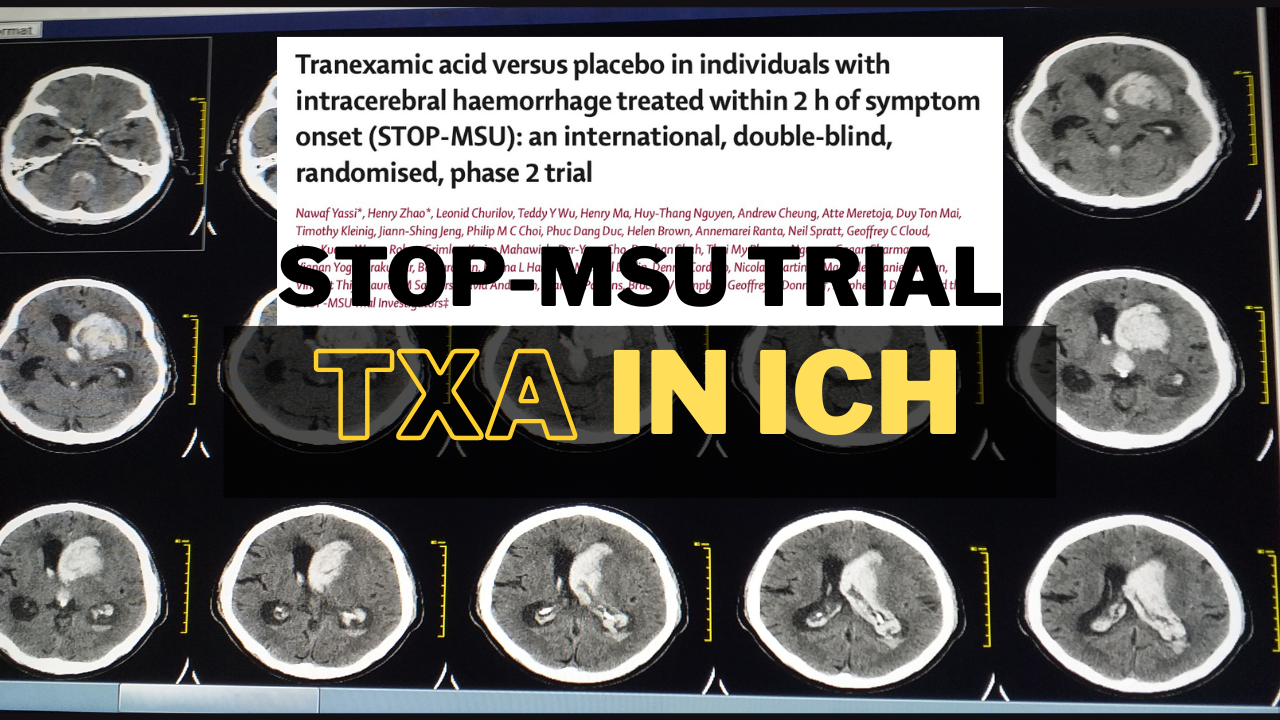
The Stopping Intracerebral Haemorrhage with Tranexamic Acid for Hyperacute onset Presentation including Mobile Stroke Units (STOP-MSU) trial aimed to determine if treatment with tranexamic acid within 2 hours of symptom onset of spontaneous intracerebral haemorrhage reduced haematoma growth, when compared to placebo.
The Study
Yassi N et al. Tranexamic acid versus placebo in individuals with intracerebral haemorrhage treated within 2 h of symptom onset (STOP-MSU): an international, double-blind, randomised, phase 2 trial. Lancet Neurol 2024; 23: 577–87
What They Did
This was an investigator-led, double-blind, Phase 2, randomised trial. It was conducted in 24 hospitals and one mobile stroke unit in Australia, New Zealand, Finland, Taiwan, amd Vietnam.
N = 201
Patients were included if they were 18 years of age or older, with a spontaneous intracerebral haemorrhage, presenting within 2 hours of stroke onset.
They excluded patients with:
-
GCS < 8
-
Brainstem haemorrhage
-
Intracerebral haematoma volume > 70 mL as measured by the ABC/2 method
-
Use of heparin, low-molecular weight heparin, GPIIb/IIIa antagonist, or oral anticoagulation (eg, warfarin/vitamin K antagonists, factor Xa inhibitor, thrombin inhibitor within the previous 72 h
-
Bleeding known or suspected to be secondary to trauma, aneurysm, vascular malformation, or other secondary causes.
The intervention was tranexamic acid 1 g IV over 10 min followed by 1 g over 8 h or IV normal saline over 10 min followed by normal saline over 8 h in the placebo group.
The haematoma size was measured via non-contrast CT and validated measuring method.
Primary Outcome: The presence or absence of intracerebral haematoma growth (at least 33% growth of 6mL absolute growth from baseline.) at 24 h (target range 18 to 30 h).
Secondary Outcomes included absolute intracerebral haematoma growth; relative intracerebral haematoma growth; absolute intraventricular haematoma growth; and absolute intracerebral plus intraventricular haematoma growth.
Secondary functional outcomes were various modified Rankin Scores and how they related to pre-stroke baseline.
Secondary safety outcomes included deaths within 7 days and 90 days and the rate of major thromboembolic events within 90 days (defined as ischaemic stroke, myocardial infarction, or pulmonary embolism).
What They Found
No significant differences in haematoma growth ocurred between the two groups. Haematoma Growth occurred in 38% of the placebo group and 43% of the Tranexamic acid group. There were no significant differences in the modified Rankin Scores of the two groups. At 7 days, eight (8%) participants in the placebo group and eight (8%) in the tranexamic acid group had died (aOR 1·08 [95% CI 0·35 to 3·35].
Tranexamic Acid was found to be safe.
My Take on This
The greatest concern I have with this study is that it uses a surrogate marker ie., haematoma growth for clinical outcomes. Although it may be an acceptable marker, it really doesn’t give us a reliable picture of clinical outcomes.
The findings in this study were that Tranexamic Acid makes no significant difference. However there are large confidence intervals. I won’t be using it for this purpose until larger trials are produced.
Read the review of the CRASH-3 Trial here that related to TXA use in traumatic intracranial haemorrhage.