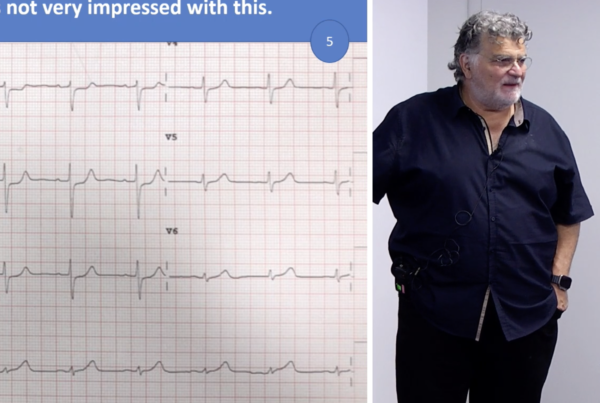
A woman at 35 weeks’ gestation presents to the emergency department with an unrelated complaint. An ECG demonstrates a short PR interval and a delta wave consistent with ventricular pre-excitation. She has no history of palpitations, syncope or documented arrhythmias.
Should we commence prophylactic flecainide or a beta blocker? What happens if she develops atrial fibrillation during labour?
WPW Pattern or WPW Syndrome?
It is important to distinguish between:
- WPW pattern: Ventricular pre-excitation without symptomatic tachyarrhythmias.
- WPW syndrome: Ventricular pre-excitation associated with clinical tachyarrhythmias.
Pregnancy increases susceptibility to arrhythmias through haemodynamic, hormonal and autonomic changes. The major concern in WPW is the development of pre-excited atrial fibrillation, which can result in extremely rapid ventricular rates and degeneration into ventricular fibrillation.
What Investigations Are Required?
- Review previous ECGs and confirm ventricular pre-excitation.
- Establish any history of palpitations, presyncope or syncope.
- Check electrolytes and magnesium.
- Arrange echocardiography to exclude structural heart disease.
- Consider ambulatory ECG monitoring.
- Arrange expedited cardiology/electrophysiology review before delivery.
A resting ECG alone cannot reliably determine whether an accessory pathway is high risk.
Should We Commence Flecainide?
Not routinely in an asymptomatic patient.
Flecainide is an established treatment option during pregnancy for patients with WPW syndrome experiencing recurrent or poorly tolerated tachyarrhythmias. However there are very few human studies on it and animal studies have shown some fetal effects at higher doses.
However, neither the 2023 HRS consensus statement nor the 2025 ESC pregnancy guidelines establishes an indication for routine prophylactic antiarrhythmic therapy in patients with incidental, asymptomatic ventricular pre-excitation.
Management should focus on risk stratification rather than automatically commencing medication.
What If the Patient Develops Pre-excited AF?
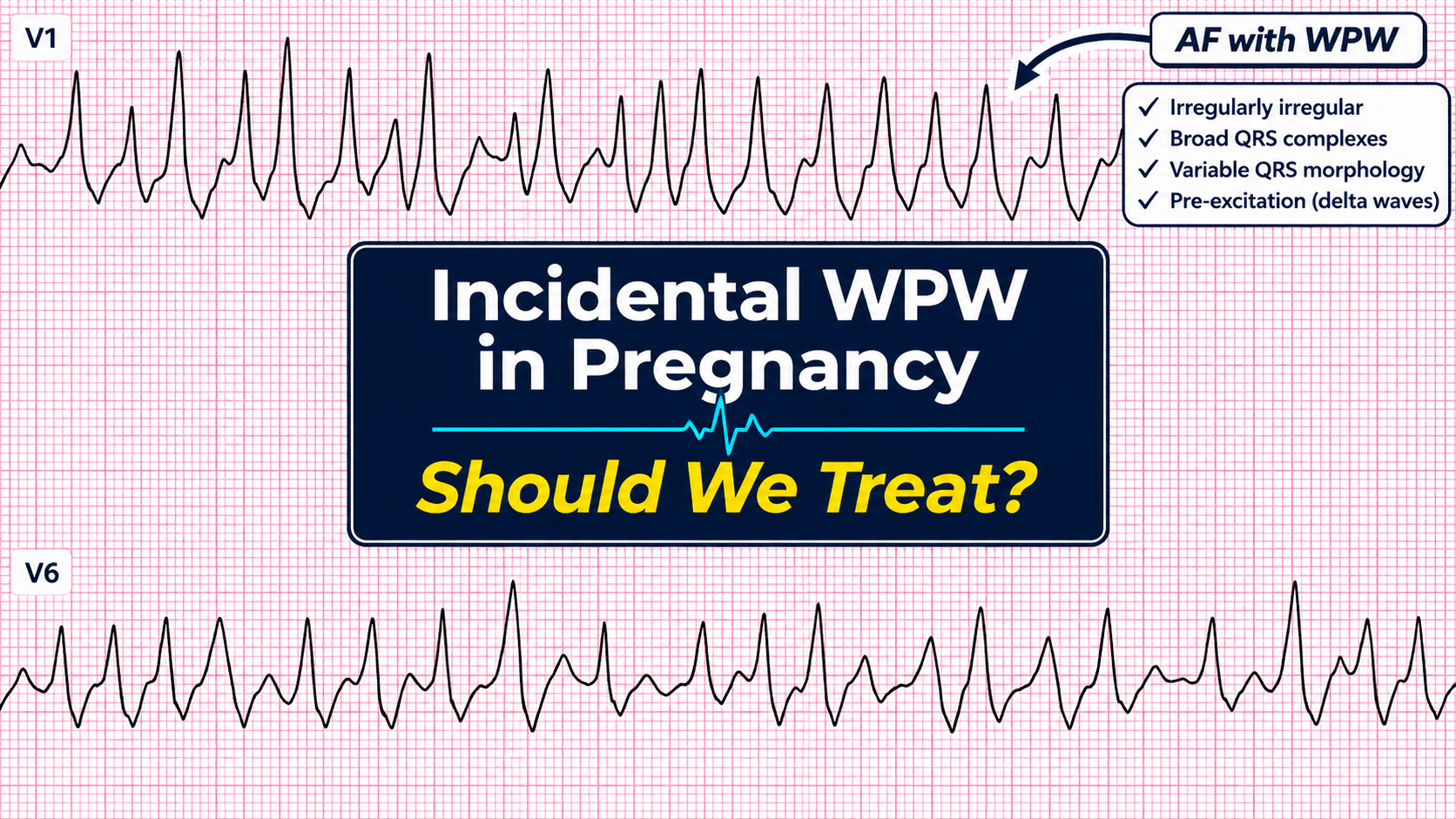
 Think of pre-excited AF when the ECG demonstrates:
- An irregular broad-complex tachycardia.
- Variable QRS morphology.
- Extremely rapid ventricular rates.
- Shortest pre-excited RR intervals of 250 ms or less, suggesting a high-risk accessory pathway.
Electrical Cardioversion
Synchronised electrical cardioversion is the preferred treatment in pregnancy, even in the haemodynamically stable patient with pre-excited AF.
The 2023 HRS consensus statement specifically recommends electrical cardioversion in this setting.
Electrical cardioversion is considered safe throughout pregnancy. Standard adult energy settings should be used, with fetal monitoring when feasible. Emergency cardioversion should not be delayed for fetal assessment or anticoagulation.
Intravenous procainamide is a potential pharmacological alternative in selected stable patients under specialist guidance, although availability may be limited in Australia.
What Drugs Should We Avoid?
In pre-excited AF, avoid:
- Adenosine
- Beta-blockers
- Verapamil
- Diltiazem
- Digoxin
- Intravenous amiodarone
These medications may facilitate rapid conduction through the accessory pathway and precipitate ventricular fibrillation.
Remember that adenosine remains an appropriate treatment for regular narrow-complex orthodromic AVRT, with appropriate monitoring and cardioversion capability.
What About Delivery?
Asymptomatic ventricular pre-excitation is not, in itself, an indication for induction or caesarean section.
A multidisciplinary management plan involving cardiology, obstetrics and anaesthesia should be established before delivery.
Electrophysiological studies and potential catheter ablation can often be deferred until after pregnancy, depending on the patient’s risk profile.
The Clinical Takeaway
Treat the arrhythmia and the risk, not simply the ECG.
- Incidental WPW does not automatically require flecainide.
- Risk stratification and a documented peripartum management plan are essential.
- Electrical cardioversion is preferred for pre-excited AF in pregnancy.
- Avoid AV nodal blocking agents in pre-excited AF, including intravenous amiodarone.
References
- 2025 ESC Guidelines for the Management of Cardiovascular Disease and Pregnancy.
- 2023 HRS Expert Consensus Statement on the Management of Arrhythmias During Pregnancy.
- 2023 ACC/AHA/ACCP/HRS Guideline for the Diagnosis and Management of Atrial Fibrillation.
- 2019 ESC Guidelines for the Management of Patients with Supraventricular Tachycardia.
For more detailed discussions on this topic and on Emergency Medicine Cardiology visit EM Mastery.