Do we need arterial lines in shock, or is non-invasive blood pressure monitoring adequate?
There is uncertainly as to the effectiveness of non-invasive blood pressure (NIBP) monitoring in shock patients. The use of invasive blood pressure monitoring is based on the need for rapid, accurate blood pressure readings, to enable intervention in the shocked patient. However the literature is sparse and recommendations are based on expert opinion.
The Study
The EVERDAC Trial
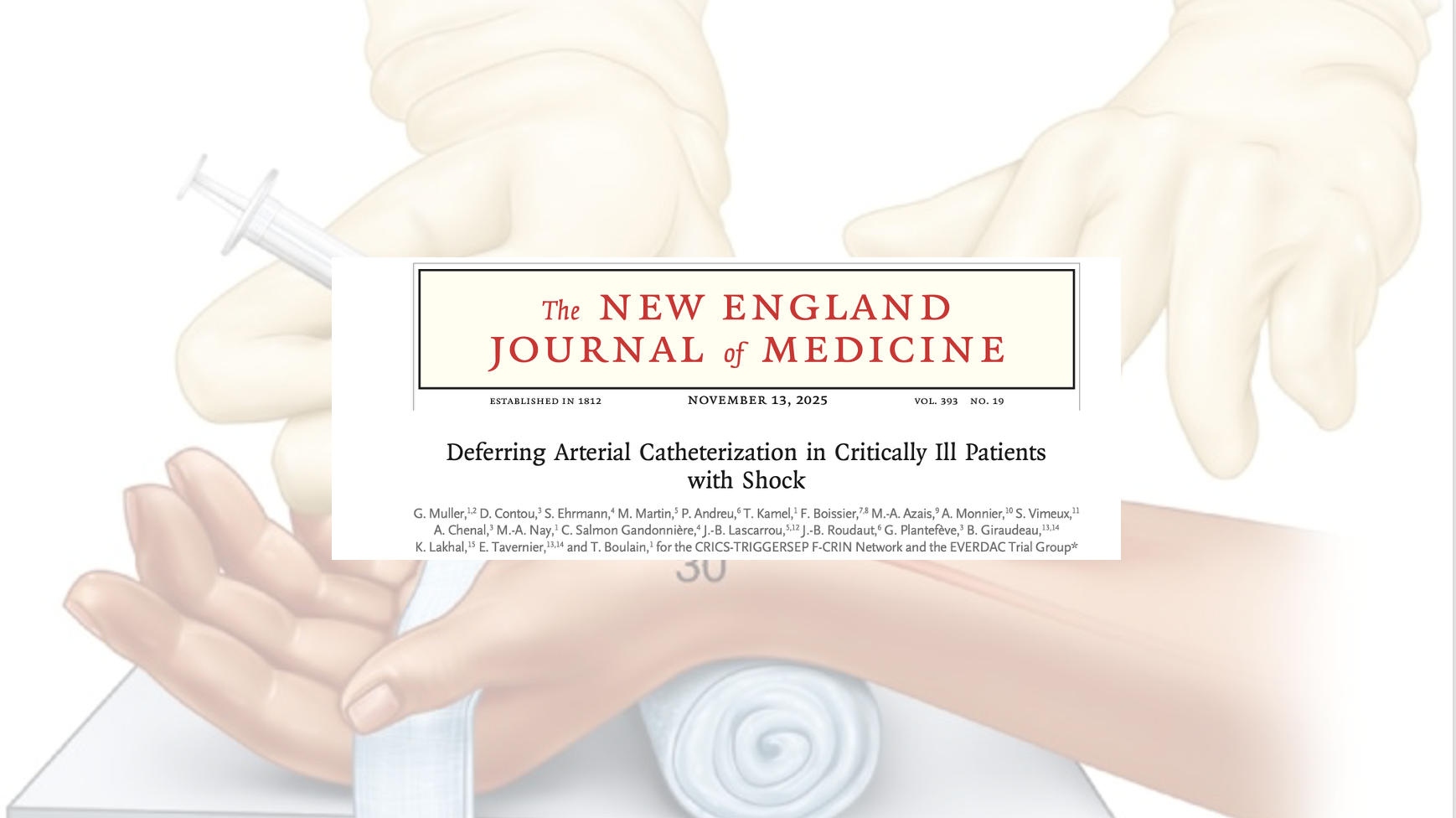
Muller G et al. Deferring Arterial Catheterization in Critically ill Patients with Shock. NEJM November 2025. 393;19. pp 1875-1888.
The Question Asked
Is managing shock without early arterial catheterization, noninferior to early catheter insertion with regard to death from any cause at 28 days?
What They Did
This was an open-label, investigator-initiated, pragmatic, multicenter, parallel-group, noninferiority, randomized, controlled trial, conducted in 9 ICUs in France.
Inclusion Criteria:
- Adult patients > 17 yo
- ICU patients eligible for enrollment within the first 24 hours after admission
- Acute circulatory failure, (persistent SBP <90 mm Hg or MAP <65 mm Hg) for > than 15 minutes
- Or initiation of vasopressor therapy, plus at least one sign of tissue hypoperfusion.
Exlusion Criteria:
- If no blood-pressure value was displayed on a NIBP device or cuff placement was impossible.
- Use of ECMO
- High dose of intravenous vasopressors (norepinephrine plus epinephrine at a dose of >2.5 μg/kg
- Severe traumatic brain injury, body-mass index
- BMI > 40
- Pregnancy
Randomisation: Patients were randomised in 1:1 ratio to non-invasive strategy vs invasive strategy (arterial catheter inserted within 4 hours of randomisation).
Outcomes:
- Primary Outcome: Death from any cause at day 28.
- Secondary Outcomes:
-
Evolution of the SOFA score over the first 7 days.
-
Number of ventilator free days.
-
Renal replacement therapy
-
Vasopressor therapy from days 1 to 28
-
Number of catheter related infections during the ICU stay
-
N = 1010
What They Found
With respect to mortality by day 28, delaying arterial catheterisation and using NIBP was non-inferior to arterial catheterisation.
Of the 1006 patients included in the intention-to-treat analysis
- 173 patients (34.3%) in the noninvasive-strategy group and
- 185 patients (36.9%) in the invasive-strategy group
had died by 28 days P=0.006 for noninferiority, P=0.20 for superiority.
The non-invasive strategy avoided arterial catheterisation in 85% of patients.
My Take On This
This is an unblinded trial and found that non-invasive blood pressure monitoring was not inferior to invasive blood pressure monitoring in shock. If we look a little more closely we see the following:
- This study predominantly looked at septic shock. We know that those patients with septic shock, may be a little forgiving in terms of a drops in blood pressure, not so, those in post ROSC shock, which can often lead to re-arrest.
- Just over 50% of patients in each of the randomisation arms had shock due sepsis.
- Only 10.7% of patients in the non-invasive arm and 7.8% in the invasive arm, were due to post ROSC Shock
- Vasopressor therapy was similar in both groups.
This is an important study, in that it shows that for certain types of shock, especially septic shock, NIBP readings may be adequate for what patients where we can record a blood pressure using a NIBP method..
What this study doesn’t cover is the accuracy of NIBP. We know that for increasing doses of pressor and for lower blood pressures, NIBP is not as accurate. The non-continuous nature of NIBP readings, don’t allow us to view the real time drop in blood pressure.
NIBP readings which measure MAP and give an estimate of SBP and DBP. The use of NIBP is therefore adeqaute if that is all we need. The invasive measurement of blood pressure, gives very specific information on systolic and diastolic blood pressures which are sometimes needed. They can give us useful information on stroke volume, the degree of vasoplegia and assist us in making treatment decisions of decisions such as when to give fluids versus increasing the vasopressor doses.
This paper won’t necessarily change my practice. In those patients where all I need is a MAP and certainly in septic shock patients where there is a blood pressure recordable, I can delay the arterial line. I like the information that I can get from an arterial line and the treatment changes it allows me to make.
However it may be useful in resource poor environments, or those where management is occurring without medical staffing, or even with medical staff, where we are getting NIBP readings and they are adequate, then NIBP may be enough.