Should We Anticoagulate Intermediate-Risk AF?
Atrial fibrillation clearly increases stroke risk, but what should we do when the patient has only one additional CHA₂DS₂-VASc risk factor?
Current guidelines suggest considering anticoagulation in men with a CHA₂DS₂-VASc score of 1 and women with a score of 2. Until now, however, this recommendation has been supported mainly by conflicting observational evidence.
The SINGLE-AF trial provides the first direct randomised evidence addressing this question. The findings may surprise you, however we must take care in the interpretation.
The study
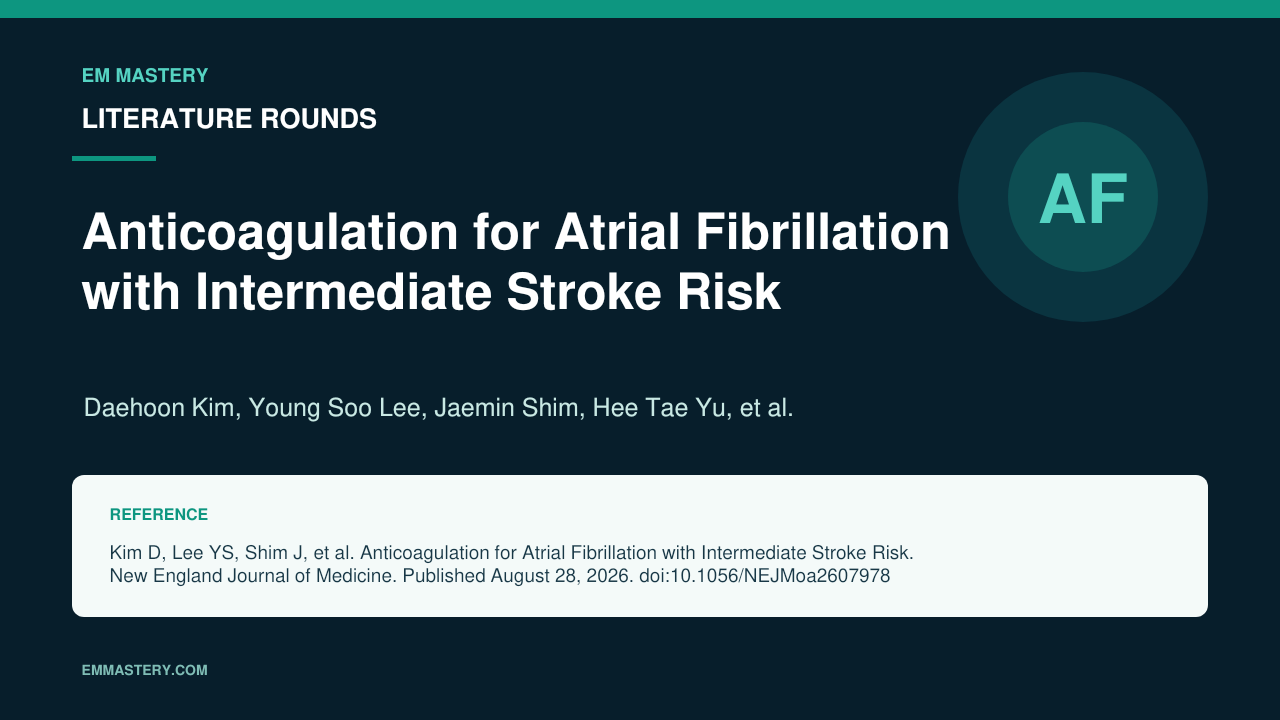
Kim D, Lee YS, Shim J, et al. Anticoagulation for Atrial Fibrillation with Intermediate Stroke Risk. N Engl J Med. Published August 28, 2026. DOI: 10.1056/NEJMoa2607978
Investigators randomised 1,803 patients with clinical AF and intermediate stroke risk to receive either a DOAC or no routine anticoagulation.
At 12 months, the primary composite of stroke, systemic embolism, major bleeding or cardiovascular death occurred in:
- 0.5% with a DOAC
- 1.5% without anticoagulation
- Absolute risk reduction: 1.0%
- NNT: approximately 100 over two years
- HR 0.31; 95% CI 0.10–0.94
The apparent benefit was driven predominantly by fewer ischaemic strokes.
Is this practice-changing?
Possibly—but there are important reasons for caution.
Only 17 primary outcome events occurred, making the treatment estimate imprecise. The population was relatively young, entirely South Korean and had a very low baseline bleeding risk. Clinically relevant non-major bleeding was numerically more frequent with DOAC therapy, and two haemorrhagic strokes occurred in the DOAC group.
The study therefore strengthens the case for discussing anticoagulation with intermediate-risk patients, but it does not mean that everyone with a CHA₂DS₂-VASc score of 1 in men or 2 in women should automatically receive a DOAC.
Why this matters in emergency medicine
These patients should not simply be labelled “low risk” and discharged without considering long-term stroke prevention.
However, SINGLE-AF addresses long-term anticoagulation, not the immediate safety of cardioversion or pericardioversion anticoagulation.
The decision still requires consideration of AF burden, the risk factor generating the score, renal function, bleeding risk, concurrent antiplatelet therapy and patient preference.
The bottom line
SINGLE-AF shifts the evidence towards anticoagulation for intermediate-risk AF—but the absolute benefit is modest, and the surprisingly small number of events means the result deserves a closer look.