Should we be targeting a higher MAP in that subset of patients with sepsis who progress to shock? There is a high mortality in this group and an even higher mortality in the subgroup of patients who are very old(1). The usual target of a MAP > 65 mm Hg, may also be inadequate in populations where there is a prevalence of hypertension, due to its effect on autoregulation.
Spoiler Alert
The trial was terminated early, as interim analysis results, suggested harm in a higher MAP target strategy.
The Study
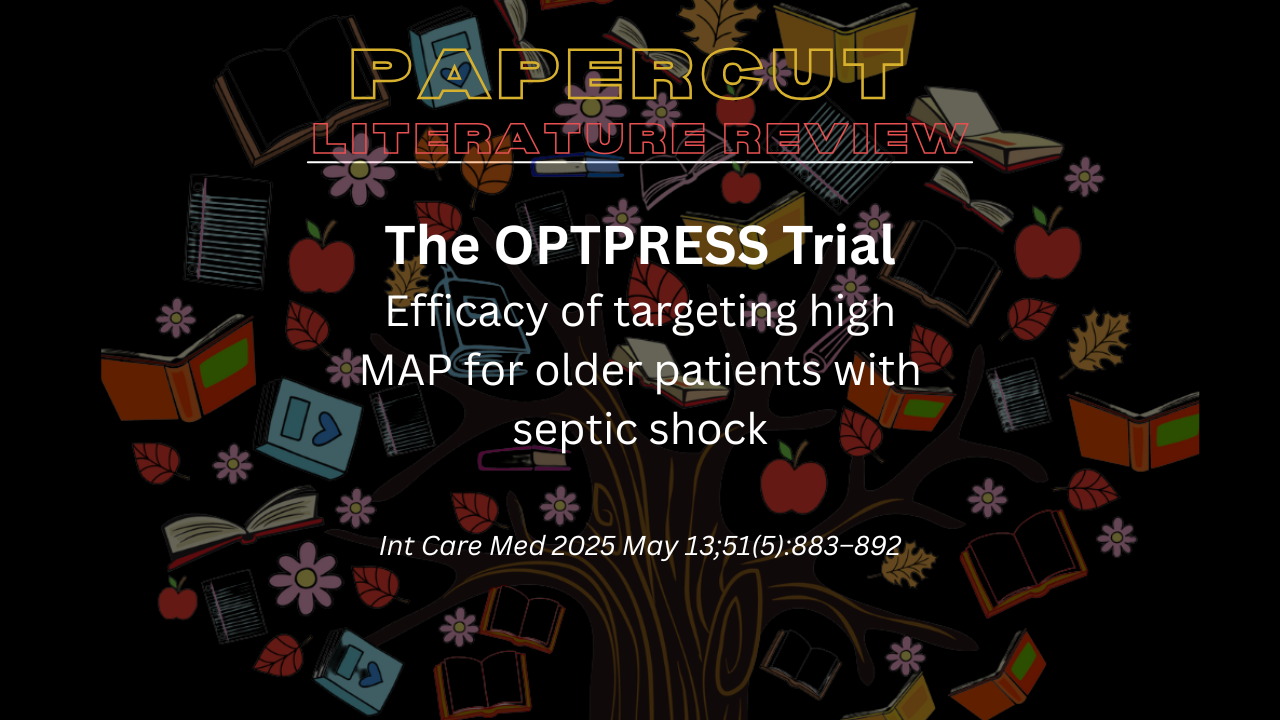
Endo A et al. Efficacy of targeting a high mean arterial pressure for older patients with septic shock(OPTPRESS): a multi centre, pragmatic, open label, randomised controlled trial. Int Care Med. 2025 May 13;51(5):883–892. PMID: 40358717
What They Did
The Question
What would be the effect of a high-target MAP, using a protocol of early concomitant use of vasopressin, in septic shock patients aged ≥ 65 years in a Japanese population where the prevalence of chronic hypertension was 66.9%?
This was a multicentre, pragmatic, open-label, randomised controlled trial at 29 Japanese centres, randomising patients >65 years old with septic shock.
Fluid resuscitation was left to the clinicians discretion and patients who had been on vasopressors for 3 or more hours were excluded.
Patients were rendomised to a higher blood pressure group (MAP = 80-85 mmHg) or a control group (65-70 mm Hg). The target MAP was maintained for 72 hours or until pressors were no longer needed. After 72 hours the target MAP was at the discretion of the treating physician.
If a noradrenaline dose of at least 0.1mcg/kg/min was required to maintain the MAP, Vasopressin was commenced and could be increased to 0.04 U/min. Following this the treating physician could choose the approach to achieve the target MAP, be it add another vasopressor, increase the noradrenaline dose, add dobutamine or give hydrocortisone.
Primary Outcome: All cause mortality at 90 days.
Secondary Outcomes: All-cause mortality at 28 days; mortality from sepsis; lactate clearance at 24 h; ventilator-free, RRT-free, and catecholamine-free days at 28 days.
What They Found
This trial was terminated early by the Safety Monitoring Committee, as predefined termination criteria for ineffectiveness or harm were met.
Patient Criteria:
- Median age was 78 years (73–85).
- The most common sources of infection were:
- the abdomen (30.2%)
- the urinary tract (26.4%) and
- the lungs (25.0%).
- Median duration from the start of norepinephrine administration to randomisation was 60 min in both groups.
- Baseline characteristics were similar between the two groups.
- 53.3% of the high-target group and 52.9% of the control group had a history of chronic hypertension.
Outcomes
Targeting a higher MAP of 80–85 mmHg significantly increased mortality compared with targeting a MAP of 65–70 mmHg. At 90 days after randomisation, 101 patients (39.3%) in the high-target group and 74 patients (28.6%) in the control group had died from any cause (risk difference = 10.7; 95% CI, 2.6 to 18.9).
Secondary outcomes of survival and organ support-free days were significantly lower in the high-target group.
Chronic hypertension appeared to have little effect on outcomes.
In this trial, fluid volume administered was similar between the two groups, the cumulative vasopressor dose was higher in the high-target group. Although there are potential vasopressor related risks, including vasoconstriction related organ damage, there were no differences in causes of death other than from sepsis.
Discussion
The present trial showed that the risks associated with vasopressors may outweigh the benefits of a higher blood pressure.
Limitations of the trial include:
- Potential bias due to the open-label design.
- There were no titration protocols for vasopressors.
- The trial was conducted in a single country.
My Take on This
Driving a higher a blood pressure in patients with shock, makes some sense. One of the concerns with shock and potential ischaemia is that the normal autoregulation curves are impaired and higher blood pressures are needed to perfuse end organs, especially in those patients with a history of chronic hypertension. This was not found to be the case as patients with chronic hypertension were targeted.
One of the things that we do see in sepsis, when compared to the ROSC patient of cardiac arrest, is the more forgiving nature of sepsis, in terms of episodes of hypotension.
Perhaps the over-use of vasoppressors and the resultant vasoconstriction, plays a role.
Also this study was in one country, it was conducted in multiple centres and the early cesation of the study due to potential harm, gives us a warning of potential overuse of pressors to target a higher MAP.
My approach is, in both the sepsis and the post ROSC patients, I will be targeting a MAP of 70 mmHg. I will increase it, if the patient appears hypo-perfused, suggested by poor urine output and a lack of lactate clearance.
References
- Bauer M, Mortality in sepsis and septic shock in Europe, North America and Australia between 2009 and 2019—results from a systematic review and meta-analysis. Crit Care 24:239 PMID: 32430052